Hair algae in an aquarium is usually caused by an imbalance between light, plant growth, nutrients, and carbon supply. The safest fix is to remove the algae by hand, reduce or stabilize the light, improve plant growth, and correct the cause instead of relying on an algae-killing chemical.
For aquarists in the United States, this problem can look different from one home to the next. Tap water in Phoenix, Seattle, Miami, and New York can have very different mineral levels and nutrient content. Tank size, measured in US gallons, also affects how quickly waste builds up. The good news is that hair algae is common, easy to identify, and usually manageable without harming fish.
Quick answer: Start with manual removal, a 20% to 30% water change, less light, and a check of feeding, flow, and plant health. Do not chase a “zero nutrient” reading. Healthy plants need nutrients, and algae often grows when plants cannot use them well.
What Is Hair Algae?
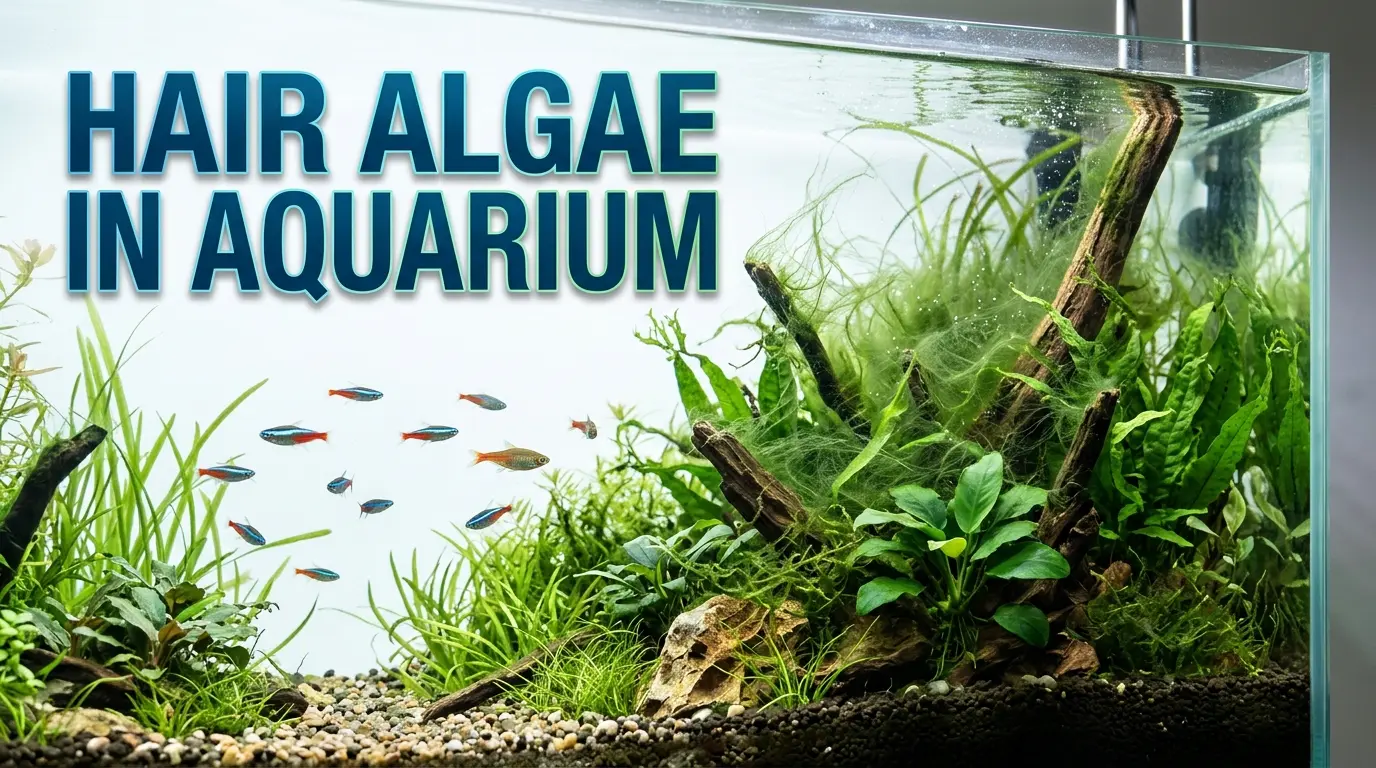
Hair algae is a group of fine, thread-like green algae that grows in soft tufts or long strands. It can attach to gravel, driftwood, rocks, plant leaves, filter parts, and aquarium decorations.
The term “hair algae” is used broadly in the aquarium hobby. It may describe several types of filamentous green algae, including:
- Fine green threads that wave in the current.
- Coarse green strands that form dense mats.
- Short, fuzzy growth on plant leaves.
- Long strands that look like green cotton or hair.
Hair algae is not the same as every green growth in a tank. Green spot algae forms hard dots on glass and slow-growing leaves. Green dust algae creates a soft film on the glass. Black beard algae forms dark gray or black tufts, often on wood and plant edges.
A simple test helps with identification. Hair algae usually pulls away in strands when you twist it around a toothbrush or plant tweezers. Black beard algae often feels tougher and stays firmly attached.
Why Does Hair Algae Grow in an Aquarium?
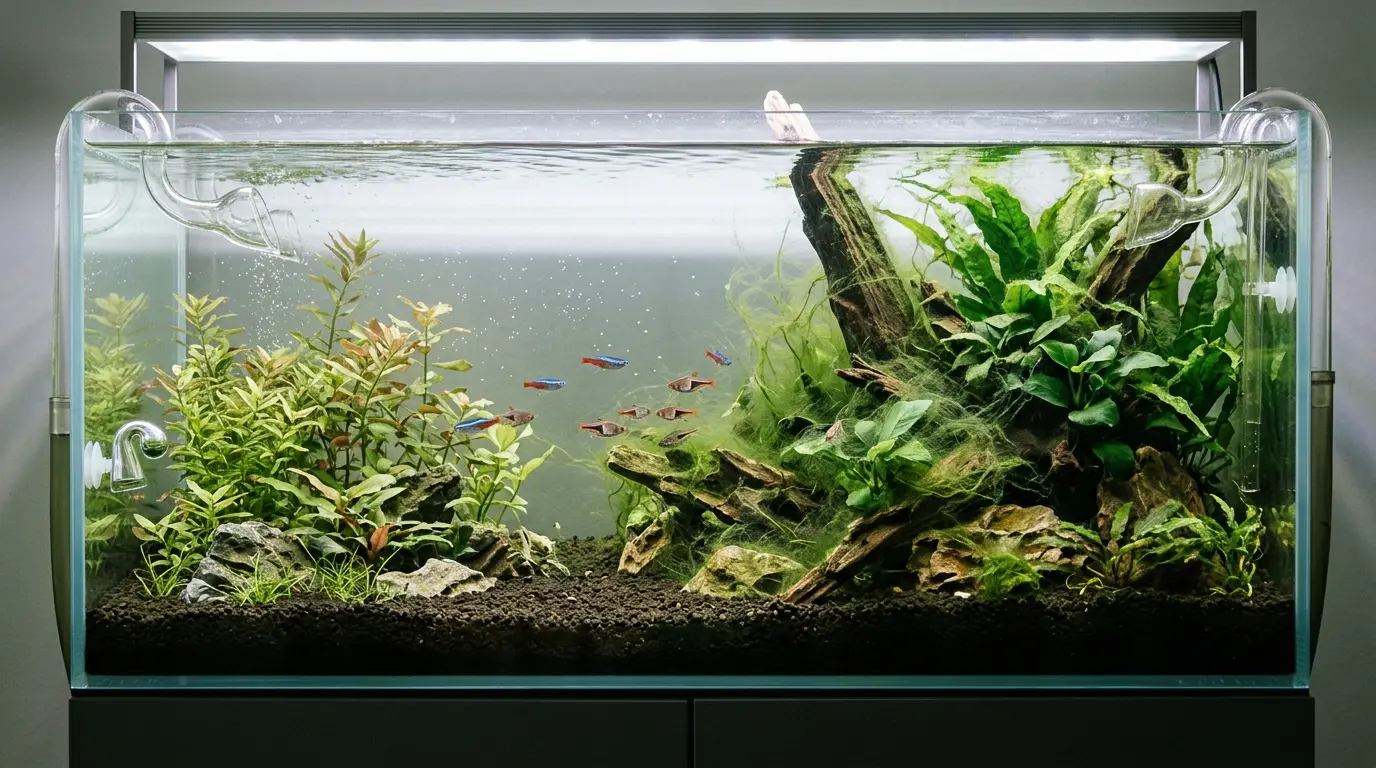
Hair algae grows when it gets enough light and access to nutrients while aquarium plants are not using those resources well. The cause is often a combination of factors, not one single mistake.
Too Much Light
Long or intense lighting is one of the most common triggers. More light gives plants more energy, but it also gives algae more energy. If plant growth, carbon supply, and nutrients do not keep pace, hair algae can gain an advantage.
A useful starting point for many freshwater planted aquariums is 6 to 8 hours of light per day. This is not a universal rule. The right schedule depends on plant type, light strength, tank depth, shade from floating plants, and whether carbon dioxide is added.
Direct sunlight can make the problem worse. A tank near a bright window may receive several extra hours of light that are not included on the aquarium timer.
Unstable Carbon Dioxide
In a planted tank with injected carbon dioxide, unstable CO₂ levels can encourage algae. This often happens when:
- CO₂ starts too late before the lights turn on.
- CO₂ stops too early.
- The bubble rate changes from day to day.
- Surface movement removes too much dissolved CO₂.
- The diffuser becomes clogged.
- The gas supply runs out.
A stable level is usually more useful than a very high level. Fish gasping at the surface, rapid breathing, or unusual hiding can signal poor oxygen conditions or excessive CO₂. If livestock shows these signs, increase surface movement and check the system at once.
Excess Waste and Uneaten Food
Fish waste, dead leaves, decaying roots, and excess food release nutrients into the water. Hair algae may take advantage of this waste, especially in a tank with slow plant growth.
Overfeeding is easy to miss. Feed only what fish can eat within a short period. Remove uneaten food when possible. A small feeding reduction can help, but sudden starvation is not needed.
Poor Plant Growth
Healthy, fast-growing plants compete with algae for light and nutrients. Plants may stop growing when they lack:
- Nitrogen.
- Potassium.
- Iron or trace elements.
- Carbon dioxide.
- Root space.
- Water movement around their leaves.
- Suitable light.
This creates an important point: hair algae can appear even when aquarium test results show low nitrate or phosphate. Algae may already be using those nutrients, or the nutrients may be available near waste zones but not evenly distributed through the tank.
Weak or Uneven Water Flow
Dead spots allow waste to collect. They can form behind rocks, under driftwood, around dense plant groups, or in corners far from the filter outlet.
Flow should move water through the entire tank without constantly blasting fish or uprooting plants. A gentle surface ripple also helps with gas exchange.
New Tank Instability
New aquariums often go through changes in bacteria, plant growth, water chemistry, and nutrient use. Hair algae may appear during this period, especially after plants shed old leaves and grow new ones.
This does not always mean the tank is failing. Remove the algae, keep maintenance steady, and avoid making several large changes at the same time.
How to Remove Hair Algae From an Aquarium
The best treatment starts with physical removal. This removes algae before it can keep growing or release fragments around the tank.
1. Remove as Much Algae as Possible
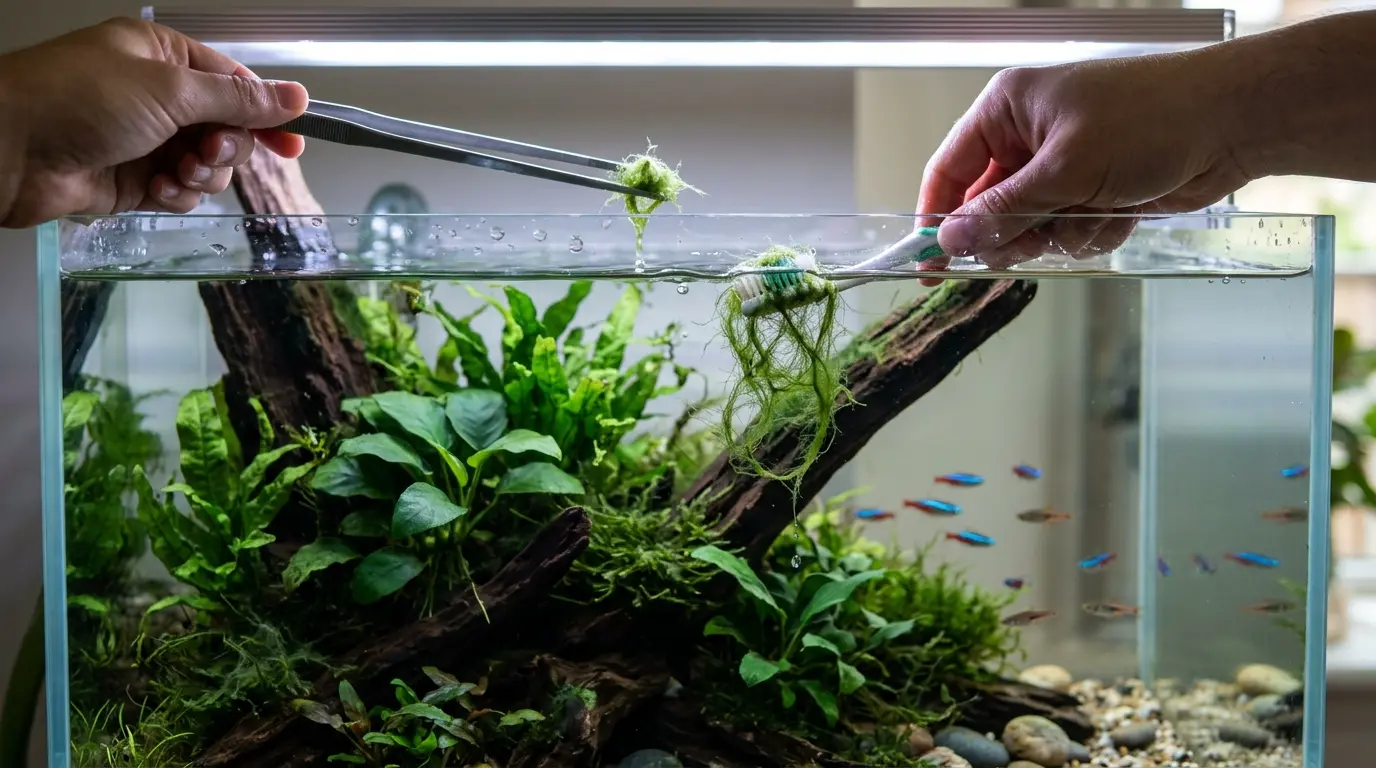
Use a clean toothbrush, algae scraper, plant tweezers, or your fingers, depending on the surface.
For long strands:
- Turn off the filter and circulation pump.
- Wrap the algae around a toothbrush or chopstick.
- Twist slowly until the strands lift away.
- Remove the clump from the tank.
- Restart the equipment after the water clears.
Do not leave loose strands floating in the aquarium. Small pieces can attach elsewhere if they remain in the water.
For heavily covered leaves, prune the worst leaves instead of trying to save every one. Removing a damaged leaf can help the plant produce healthy new growth.
2. Perform a Moderate Water Change
A water change helps remove suspended waste and dilute dissolved nutrients. For most routine cases, replace about 20% to 30% of the aquarium water.
Use water treated with a suitable dechlorinator. Match the new water temperature as closely as practical. Large, sudden changes can stress fish and invertebrates, especially in tanks with unstable pH or temperature.
Vacuum the substrate in areas where food and waste collect. Avoid deep-cleaning every part of the aquarium at once because beneficial bacteria live on surfaces throughout the system.
3. Shorten the Light Period
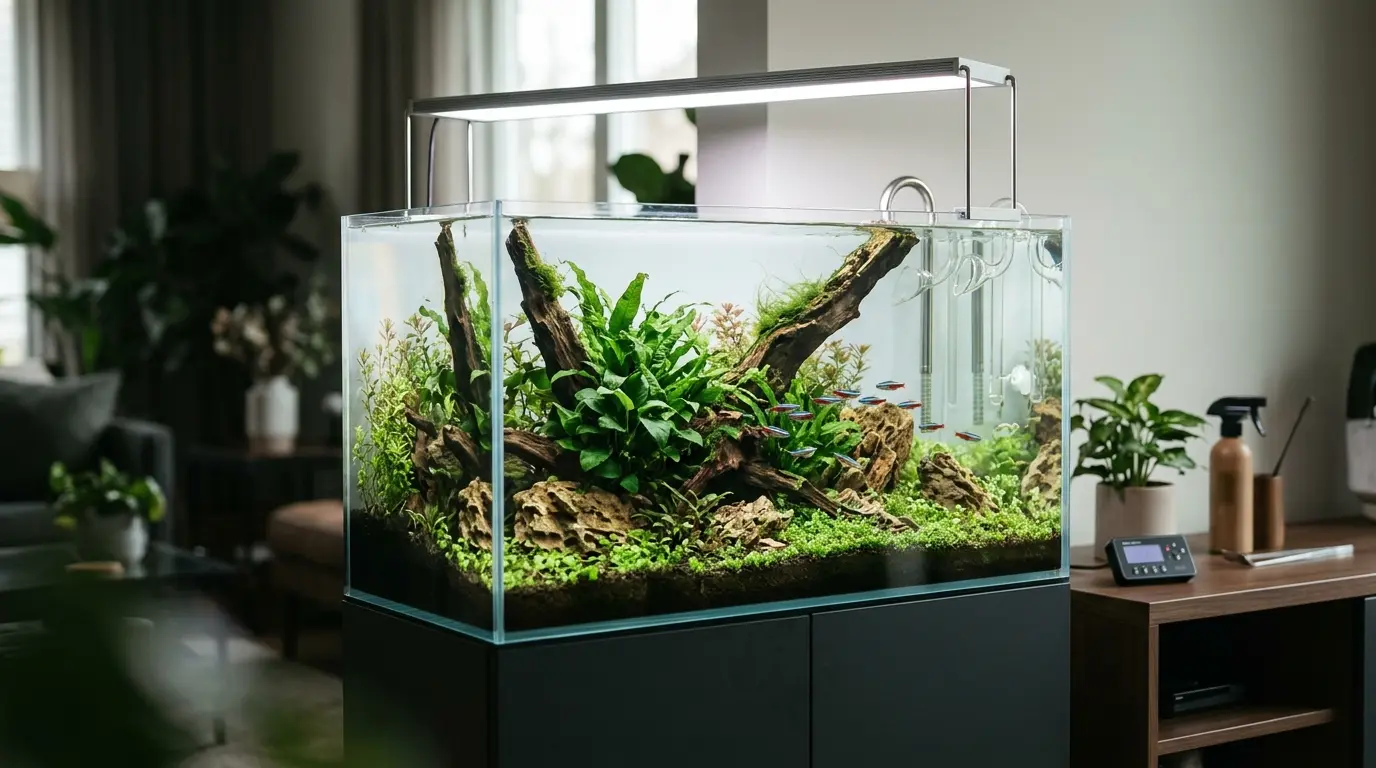
Reduce the light period by 1 to 2 hours for two to three weeks. A timer makes this change consistent.
Also check:
- Whether sunlight reaches the aquarium.
- Whether the light is brighter than the plants need.
- Whether the fixture has a high-output setting.
- Whether floating plants create uneven shade.
- Whether the light turns on before CO₂ begins in an injected system.
Do not place the aquarium in complete darkness for long periods unless you understand the risks. A blackout can weaken plants and does not correct the cause of recurring algae.
4. Improve Plant Growth
Add or trim plants based on the tank’s needs. Fast-growing plants can help use available nutrients while you correct the problem.
Useful choices may include:
- Water sprite.
- Hornwort.
- Guppy grass.
- Vallisneria.
- Hygrophila.
- Rotala.
- Amazon sword in larger aquariums.
Plant choice depends on the tank’s light, water chemistry, fish, and available space. Adding plants alone will not solve severe algae if the light is still excessive or the plants are already struggling.
Remove yellow, melting, or decaying leaves. Dead plant matter adds waste and can shade healthy growth.
5. Check Flow and Filter Maintenance
Make sure the filter is moving water through the tank. Clean clogged intake sponges and hoses in removed aquarium water, not under chlorinated tap water.
Do not replace all filter media at once unless there is a specific reason. A gentle rinse preserves more of the helpful bacteria that support biological filtration.
Aim the outlet so the tank has broad circulation and mild surface movement. If algae grows only in one corner, poor flow is a likely part of the cause.
Should You Use Algae-Eating Fish or Shrimp?
Algae-eating animals can help control small amounts of hair algae, but they should not be the main treatment. Every species has different needs, adult size, behavior, and diet.
Amano Shrimp
Amano shrimp are often useful in planted aquariums. They may graze on soft algae and leftover food. They work best in groups and established tanks with safe hiding places.
They may not control a large, dense mass of mature hair algae. Some fish may also eat them, and they can be sensitive to sudden changes in water chemistry.
Siamese Algae Eaters
A true Siamese algae eater, commonly sold as Crossocheilus siamensis, may eat some filamentous algae when young. It grows larger than many people expect and needs suitable space and tank mates.
Do not add one only to solve an algae problem. Confirm the species before buying it. Several fish are sold under similar names but may have different diets and behavior.
Nerite Snails
Nerite snails are effective on many hard algae types, especially algae on glass and solid surfaces. They are less reliable against long hair algae.
They may leave small white egg spots on hard surfaces. These eggs generally do not develop into a population in normal freshwater conditions, but the spots can be a cosmetic concern.
Avoid Overstocking for Algae Control
An algae eater is still a living animal with waste, food, and space needs. Adding too many animals can increase the waste that helped create the algae in the first place.
Choose livestock for long-term suitability, not as a temporary tool.
Do Aquarium Chemicals Kill Hair Algae?
Some aquarium products can damage or kill algae, but chemical treatment carries more risk than manual removal and better maintenance.
Liquid carbon products, algaecides, and hydrogen peroxide treatments are not interchangeable. Their ingredients, strengths, and instructions vary by brand. Some can harm shrimp, snails, fish, mosses, Vallisneria, delicate plants, or beneficial microorganisms.
Before using any treatment:
- Read the product label for the exact formulation.
- Check whether it is safe for shrimp, snails, plants, and fish.
- Never exceed the labeled amount.
- Do not mix algae treatments.
- Remove dead algae with a siphon or net.
- Increase aeration if the label requires it or livestock shows stress.
- Keep chemicals away from children and pets.
Spot treatment can be especially risky. A concentrated chemical placed on a plant, fish, shrimp, or snail can cause local damage even when the full-tank dose seems low.
Chemical treatment also has a limit: it may remove visible algae without fixing the reason it grew. If lighting, waste, flow, or plant growth remains unchanged, the algae can return.
A UV sterilizer may help with free-floating algae that turns water green. It usually does not remove hair algae attached to plants, wood, or rocks.
A Simple Hair Algae Troubleshooting Plan
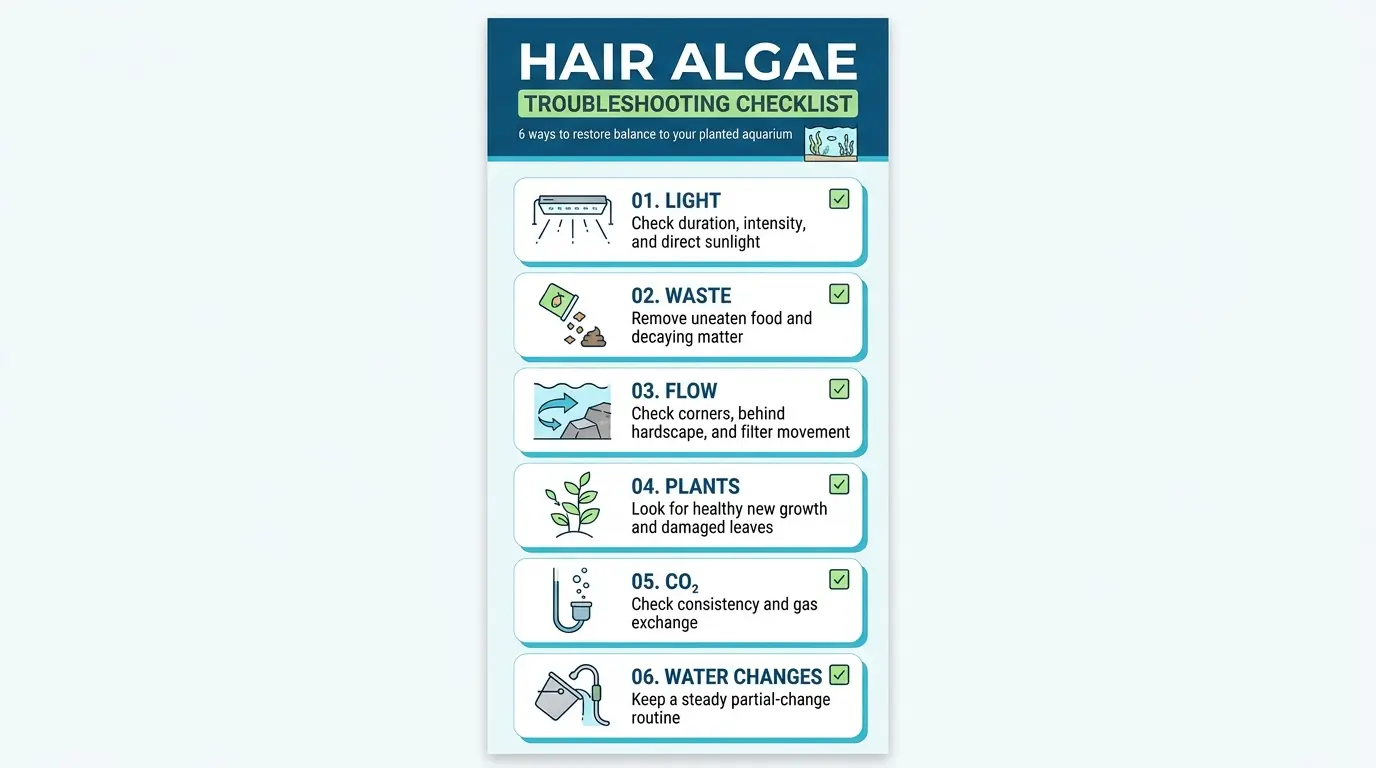
Use this order so you correct the most likely causes without changing too much at once.
| Check | What to look for | Practical action |
|---|---|---|
| Light | More than 8 hours, strong output, or direct sun | Reduce the schedule and block direct sun |
| Waste | Uneaten food, dirty substrate, dead leaves | Feed less, vacuum waste, remove decay |
| Flow | Algae in corners or behind objects | Adjust the outlet and clean blocked equipment |
| Plants | Melting leaves or no new growth | Prune damaged leaves and check plant needs |
| CO₂ | Unstable timing or fish gasping | Stabilize the system and improve gas exchange |
| Water changes | Long gaps between maintenance | Use a consistent partial-change schedule |
| Livestock | Too many animals for the tank | Avoid adding more algae eaters |
Make one or two changes first. Then watch the tank for about two weeks. Algae that stops getting longer is already a positive sign, even if old strands remain.
Test nitrate and phosphate if you have reliable tests, but do not treat a single test result as the whole answer. Test kits vary, and a reading can change after feeding, a water change, or algae growth.
How to Prevent Hair Algae From Returning
Prevention depends on consistency more than aggressive cleaning. A stable routine gives plants a better chance to outcompete algae.
A practical routine for many freshwater tanks includes:
- Use a timer for a steady light schedule.
- Remove visible algae during weekly maintenance.
- Feed fish carefully and remove excess food.
- Prune dying leaves before they decay.
- Vacuum areas where waste collects.
- Clean filter equipment when flow drops.
- Keep water movement broad and gentle.
- Avoid sudden changes in light, fertilizer, or CO₂.
- Record test results so you can spot trends.
- Quarantine new plants when practical and inspect them for algae.
Do not aim for sterile conditions. A healthy aquarium contains bacteria, microorganisms, and small amounts of algae. The goal is balanced growth that does not cover plants or stress livestock.
A tank with strong light and injected CO₂ may need more precise dosing and maintenance than a low-light tank. Neither setup is automatically better. The deciding factor is whether the routine matches the equipment and plant demand.
Common Mistakes When Treating Hair Algae
Scrubbing Without Changing the Cause
Removing algae makes the tank look better, but it does not stop new growth. Pair manual removal with a light, waste, flow, or plant-growth adjustment.
Chasing Zero Nitrate and Phosphate
Plants need nutrients. Extremely low readings can slow plant growth and create a poor balance between light and plant demand. Test results should guide decisions, not create fear.
Making Several Large Changes at Once
A major water change, new light, fertilizer cut, CO₂ adjustment, and new livestock can make it hard to know what helped. Large swings may also stress fish and invertebrates.
Adding Too Many Algae Eaters
More animals create more waste. They also may not eat the type of algae in your tank.
Using a Blackout as the Only Fix
A blackout may weaken some algae, but it can also weaken plants. Hair algae often returns if the light schedule and maintenance routine stay the same.
Cleaning the Filter With Tap Water
Chlorinated water can damage helpful bacteria in filter media. Rinse biological media gently in water removed during an aquarium water change.
When Is Hair Algae a Sign of a Bigger Problem?
Hair algae is usually a maintenance issue, but urgent action may be needed if fish are gasping, dying, or showing signs of chemical stress.
Check ammonia and nitrite when:
- The aquarium is newly set up.
- Fish were recently added.
- Filter media was replaced or heavily cleaned.
- A fish has died in the tank.
- Medication or chemical treatment was recently used.
- The water is cloudy and livestock acts distressed.
Ammonia and nitrite should be treated as serious water-quality concerns. Do not assume algae is the cause of fish illness.
If hair algae returns despite stable light, feeding, flow, and maintenance, test the source water. Some US municipal water supplies vary by season or location. A local water quality report or a quality test can reveal nitrate, hardness, alkalinity, or other factors that affect aquarium management.
Frequently Asked Questions
Is hair algae harmful to fish?
Small amounts are usually not harmful. Dense growth can trap debris, cover plant leaves, reduce water movement, and make maintenance harder. Long strands may also tangle around delicate plants or equipment.
Does high nitrate always cause hair algae?
No. High nitrate can support algae, but hair algae may also grow when nitrate tests low. Algae can consume nutrients quickly, and poor plant growth may leave light available for algae.
Will reducing light kill hair algae?
Reducing light can slow or weaken hair algae, especially when the schedule was too long or the tank receives sunlight. It works best when combined with manual removal and better maintenance.
Can I use hydrogen peroxide on hair algae?
Hydrogen peroxide can damage algae, but it can also harm fish, shrimp, snails, plants, and beneficial organisms if used incorrectly. Use it only when the exact product instructions support the treatment, and follow the label carefully.
How long does it take to get rid of hair algae?
A small outbreak may improve within one to three weeks after consistent removal and correction of the cause. Severe outbreaks can take longer. Old algae may remain until it is physically removed, even after new growth stops.
Should I remove plants covered in hair algae?
Remove badly affected leaves first. Discard a plant only when most of it is damaged or the plant is difficult to clean safely. Healthy new growth is a better sign of recovery than the appearance of old leaves.
Key Takeaways
- Hair algae grows when light, nutrients, and plant demand are out of balance.
- Remove it by hand before changing the aquarium.
- Start with a steady 6-to-8-hour light schedule unless your setup requires something different.
- Check feeding, dead leaves, water flow, and filter condition.
- Do not assume zero nitrate or phosphate is the goal.
- Treat algae-eating animals as long-term livestock, not disposable cleaners.
- Use chemical products only after checking their exact safety instructions.
- If fish show stress, test ammonia and nitrite and act on water-quality problems first.
Conclusion
Hair algae in an aquarium is a signal that the tank’s light, waste, flow, or plant growth needs a closer look. It is rarely solved by one product or one algae-eating animal.
Start with the safest steps: remove the algae, reduce excess light, improve circulation, limit waste, and support healthy plant growth. Watch the tank for two weeks, keep the routine steady, and adjust only when the evidence points to a clear problem.