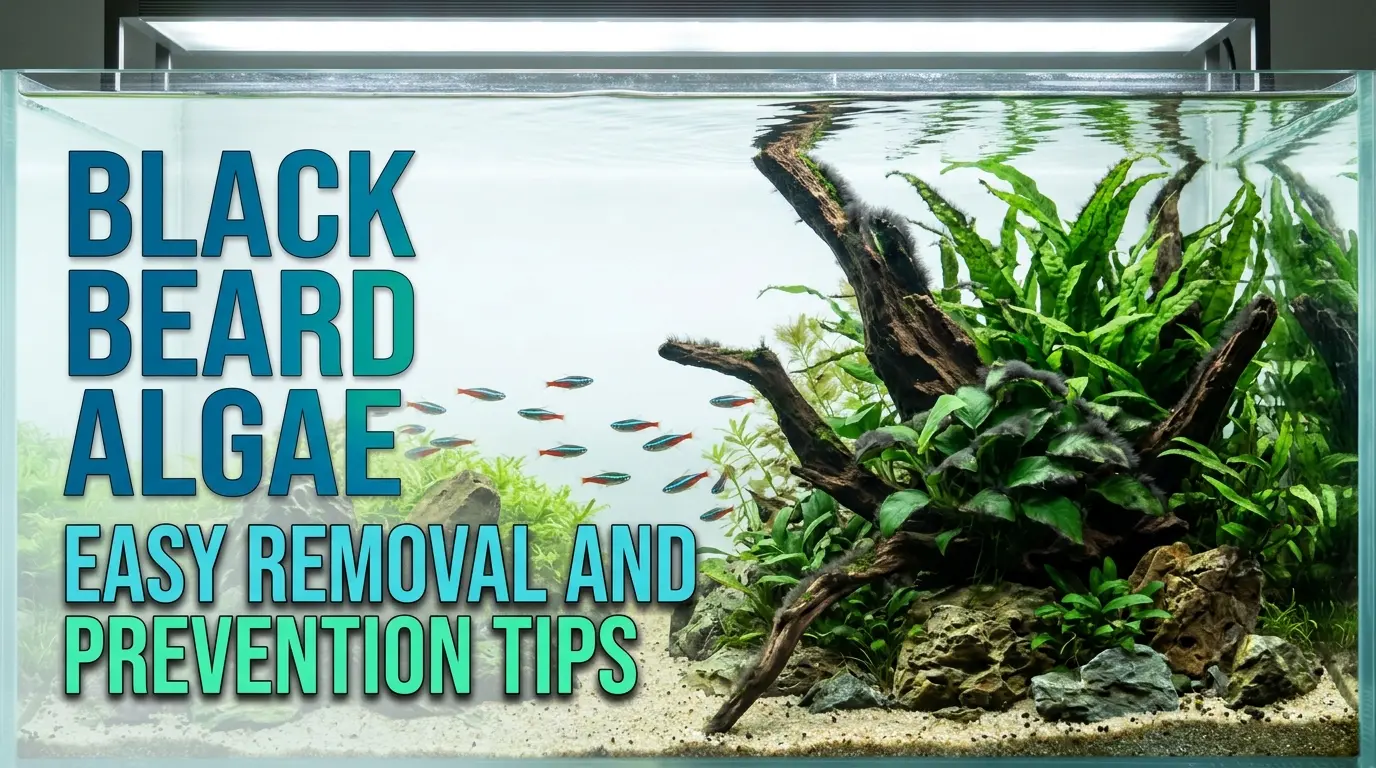
For aquarium keepers in the United States, black beard algae (BBA) is one of the most stubborn forms of algae to find on plants, driftwood, rocks, and filter parts. It looks like short black, gray, or dark green tufts. Once it takes hold, simple glass cleaning often will not solve the problem.
The best approach is not to chase one “magic” cause. Remove as much algae as you can, improve tank stability, reduce excess waste, and give new growth less chance to return. This guide explains how to identify black beard algae, remove it safely, and prevent another outbreak.
What Is Black Beard Algae?
Black beard algae is a common name for tuft-forming red algae in the order Ceramiales. In aquariums, it is often linked to algae in the genus Audouinella, although hobby identification is not always exact without laboratory testing.
Despite its name, BBA may look:
- Black
- Gray
- Dark green
- Purple or reddish under strong light
Young growth often looks like soft fuzz. Older growth becomes coarse and wiry. It may form small tufts on leaf edges or dense patches across hard surfaces.
Black beard algae is not the same as:
- Green spot algae, which forms hard green dots
- Hair algae, which grows in long, loose strands
- Staghorn algae, which has branching, antler-like growth
- Blue-green algae, which is a type of cyanobacteria, not true algae
BBA can attach to almost any surface. Common sites include:
- Slow-growing plant leaves
- Anubias and Java fern
- Driftwood
- Aquarium rocks
- Filter outlets
- Heater guards
- Aquarium glass
- Silicone seams and equipment
A small patch is easier to remove than a mature colony. Early action usually means less plant damage and less need for chemical treatment.
What Causes Black Beard Algae?
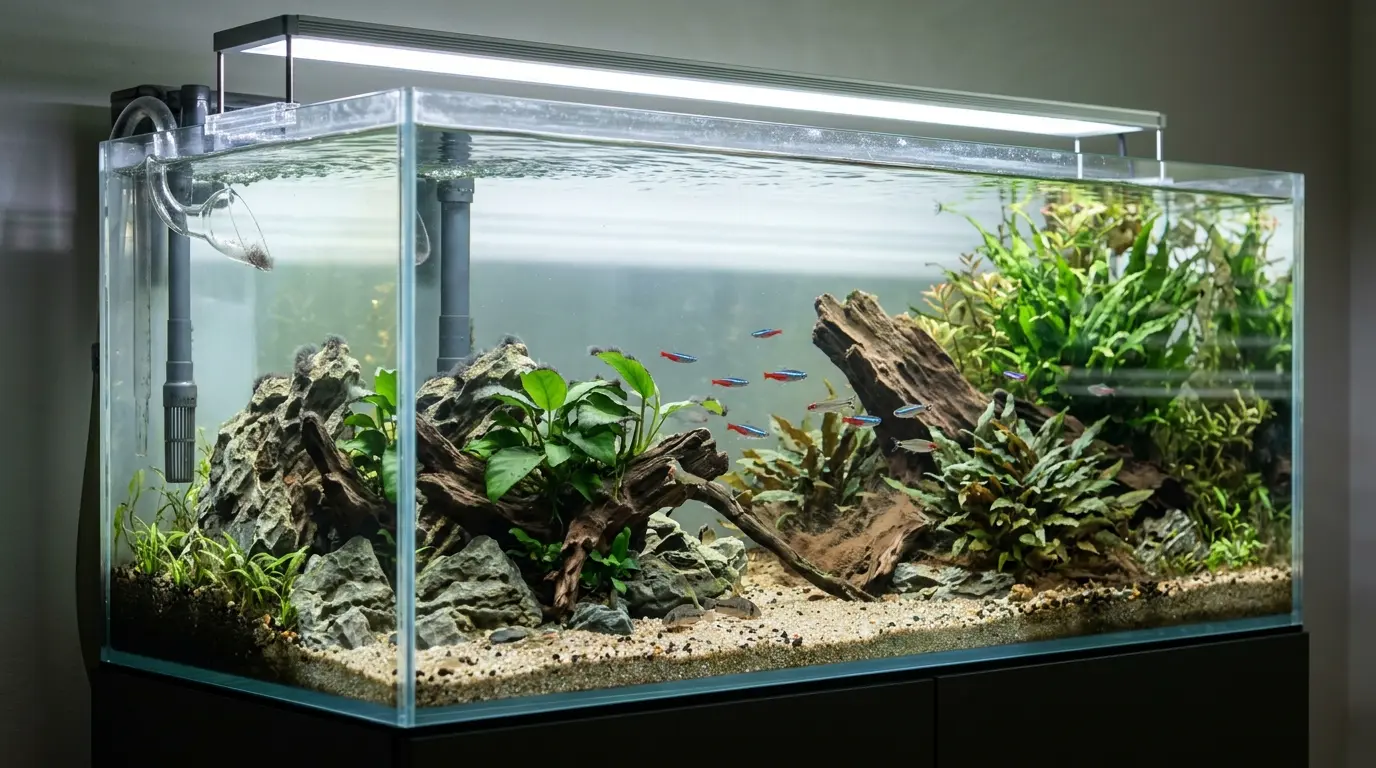
Black beard algae usually appears when a tank has unstable conditions, excess organic waste, or an imbalance between light, carbon, plant growth, and maintenance. There is rarely one cause that explains every outbreak.
Unstable carbon dioxide
In planted aquariums, unstable carbon dioxide can stress plants and slow their growth. When plants do not use light and nutrients well, algae may gain an advantage.
This does not mean that every BBA outbreak comes from low carbon dioxide. Many low-tech tanks grow healthy plants without injected CO2. The more useful lesson is to avoid sudden swings.
If you inject CO2, check:
- Whether the system turns on and off at consistent times
- Whether the diffuser is clean
- Whether bubbles enter the tank evenly
- Whether fish gasp near the surface
- Whether the drop checker or test method changes sharply during the day
Too much CO2 can harm fish and invertebrates. Never raise CO2 quickly just to fight algae.
Excess organic waste
Black beard algae often grows where dissolved waste collects. Sources may include:
- Overfeeding
- Dead plant leaves
- Fish waste
- Dirty filter media
- Blocked filter intakes
- Poor circulation behind decorations
- A heavily stocked aquarium
- Decomposing wood or plant matter
A filter can be running while waste still builds up in dead spots. Look behind rocks, under wood, and around dense plant growth.
Excess or poorly controlled light
Light does not automatically cause BBA. Plants need light to grow. However, strong light can make algae problems worse when plant growth, carbon supply, and maintenance do not keep pace.
Check:
- Light intensity
- Daily light duration
- Direct sunlight from windows
- Sudden changes in lighting
- Whether floating plants block light unevenly
A long photoperiod can add pressure to a tank. Reducing the schedule modestly may help, but darkness alone will not correct dirty equipment or unstable water conditions.
Poor water movement
BBA can appear near filter outlets, but this does not prove that strong flow causes it. More often, flow patterns move waste and carbon unevenly through the aquarium.
Improve circulation when you see:
- Debris settling in one corner
- A surface film
- Leaves covered in dust
- Plants not moving at all
- BBA growing in low-flow pockets
Do not aim a powerful jet directly at delicate plants or small fish. The goal is even circulation, not maximum force.
Nutrient imbalance
BBA is often blamed on high nitrate or phosphate. That explanation is too simple.
Plants need nitrogen, phosphorus, potassium, carbon, and trace elements. Very low nutrients can limit plant growth, while excess nutrients may reflect poor maintenance or heavy waste. Test results should guide your response, not replace observation.
Do not strip the tank of nutrients without a reason. Starved plants may become weaker and provide less competition for algae.
How to Remove Black Beard Algae
The most reliable method combines physical removal, better tank care, and patience. Chemical treatment may help with stubborn patches, but it should not replace the cause-and-care steps.
Step 1: Remove affected leaves and objects
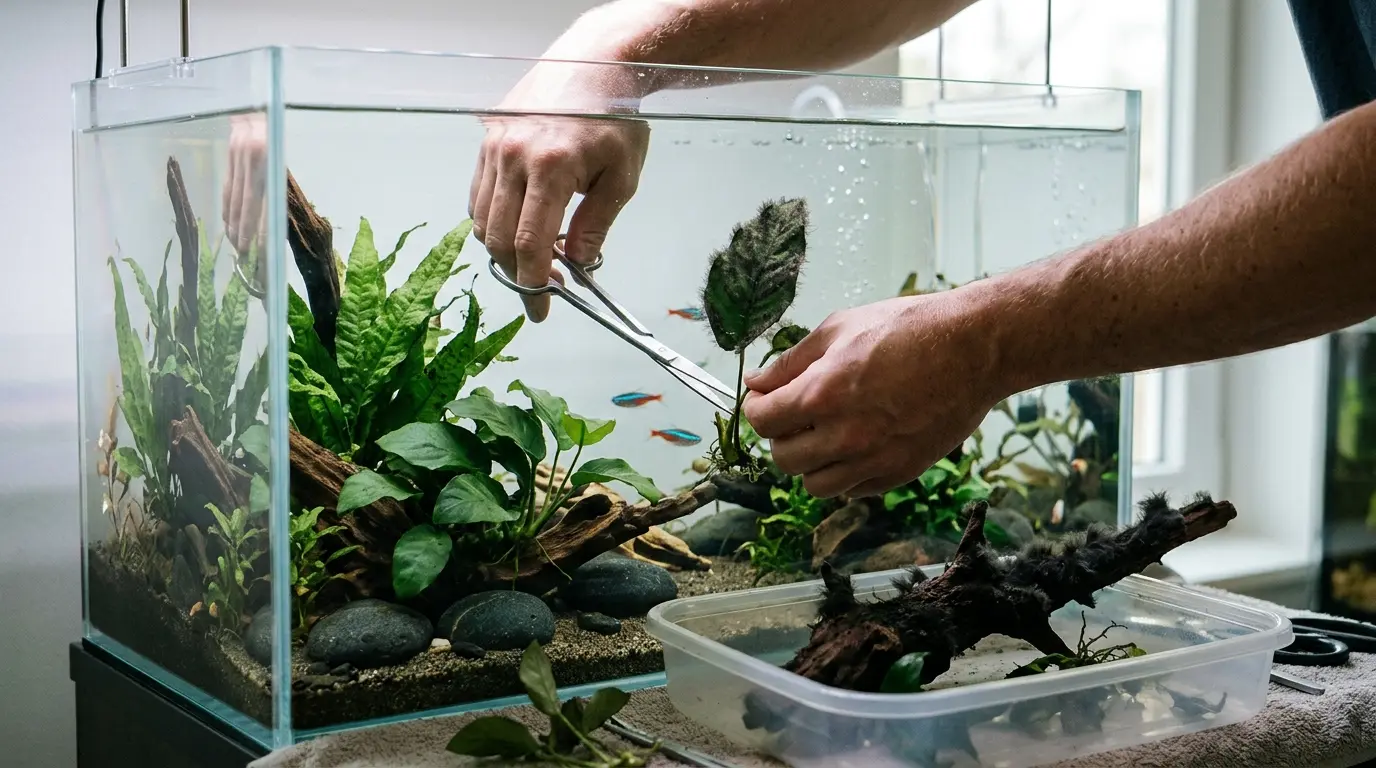
Trim badly covered leaves with clean aquarium scissors. This works well for slow-growing plants such as Anubias and Java fern when the algae covers most of the leaf.
Remove decorations, rocks, or equipment if you can clean them outside the aquarium. This limits exposure to fish and invertebrates.
Do not remove a healthy plant just because one leaf has BBA. Cut the affected leaf near its base and leave the rhizome or root system intact.
Step 2: Manually scrub hard surfaces
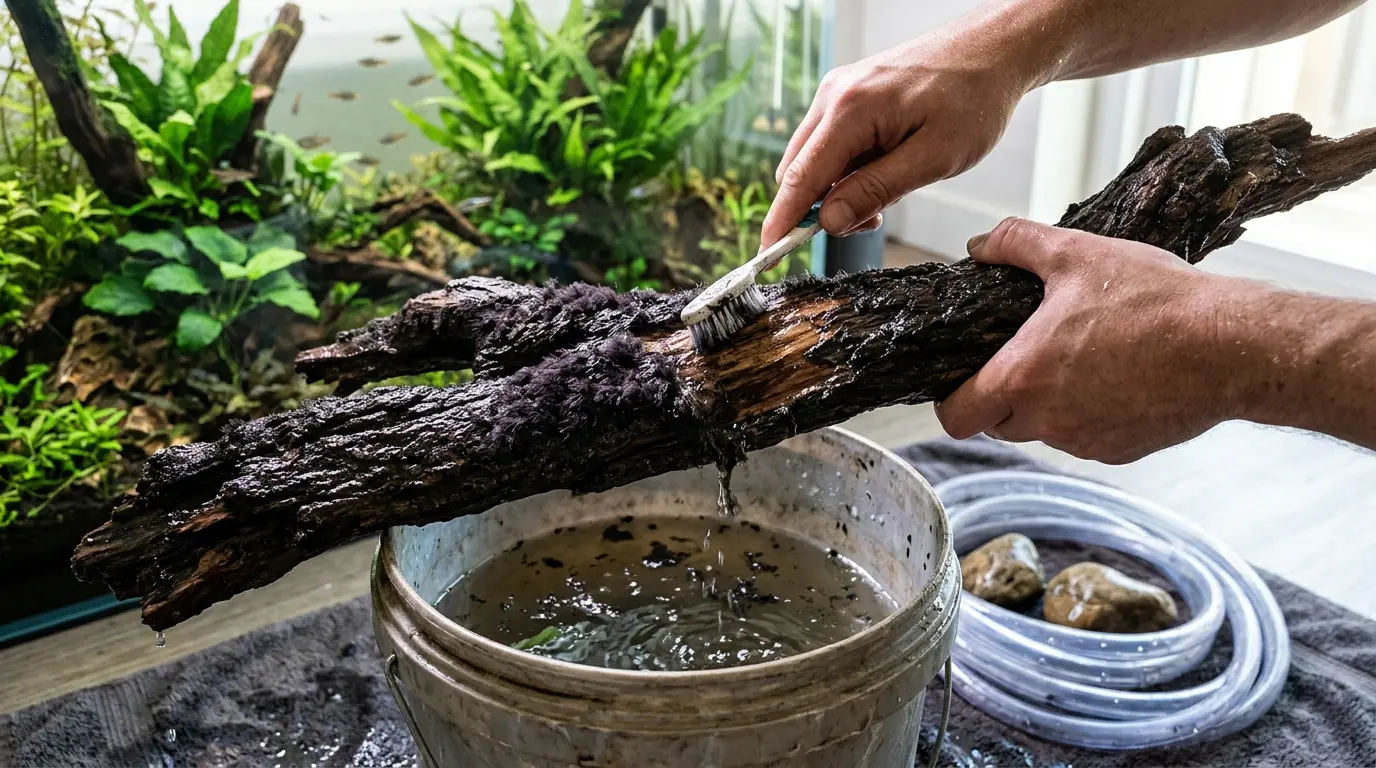
Use a new aquarium-safe toothbrush or algae brush on:
- Rocks
- Driftwood
- Intake pipes
- Heater guards
- Filter tubing
- Removable decorations
Scrub in a bucket of discarded aquarium water when possible. This keeps loosened algae and waste out of the main tank.
For glass, use an algae scraper that matches the tank surface. Check that the tool is safe for acrylic aquariums, because some glass scrapers can scratch acrylic.
Step 3: Siphon loose debris
After trimming and scrubbing, siphon the debris during a water change. This prevents fragments and trapped waste from settling elsewhere.
Vacuum the substrate gently. Avoid stirring the entire bed at once, especially in an established aquarium with delicate roots or burrowing animals.
Step 4: Improve routine maintenance
A practical maintenance plan may include:
- Removing dead leaves each week
- Cleaning the filter intake
- Checking flow around decorations
- Wiping the glass before algae becomes thick
- Feeding only what fish consume promptly
- Testing water when the tank changes
- Performing regular partial water changes suited to the aquarium
There is no single water-change schedule that fits every US aquarium. Stocking, feeding, plant mass, filtration, and substrate all matter.
Step 5: Use chemical treatment only when appropriate
Some aquarists use 3% hydrogen peroxide for spot treatment outside the tank. Others use commercial liquid carbon products. These methods can damage plants, shrimp, snails, fish, beneficial bacteria, or silicone if used incorrectly.
Before treatment:
- Read the product label.
- Confirm that the product is intended for aquarium use.
- Identify every fish and invertebrate in the tank.
- Check whether the plant species is sensitive.
- Turn off circulation only if the label or method requires it.
- Keep treatment away from fish gills and exposed animal tissue.
- Restore normal flow before animals show stress.
For removable objects, a safer option is often to take the item out, scrub it, and treat it separately according to the product label. Never mix hydrogen peroxide with bleach, acids, or other cleaners.
Bleach can kill algae on removable equipment, but it must be fully rinsed and dechlorinated before the item returns to the aquarium. Do not use household cleaners on objects that will go back into a tank unless the method is specifically designed for aquarium use.
Black Beard Algae Treatment Options Compared
The table below shows when each method makes sense and what limits it.
| Method | Best use | Main benefit | Main risk or limit |
|---|---|---|---|
| Trim affected leaves | Plants with heavy coverage | Removes the algae at once | Reduces leaf area |
| Brush and siphon | Rocks, wood, glass, equipment | Low chemical risk | Missed patches can return |
| Improve flow | Dead spots and waste buildup | Helps distribute oxygen and nutrients | Too much flow can stress livestock |
| Reduce light duration | High-light or long-day tanks | Lowers algae pressure | Does not remove existing BBA |
| Clean filter and substrate | Waste-related outbreaks | Removes trapped organic matter | Excessive cleaning can disturb beneficial bacteria |
| Hydrogen peroxide | Carefully selected spot treatment | Can weaken or kill exposed algae | Can injure plants and animals |
| Liquid carbon | Label-approved aquarium use | May suppress some algae | Product effects vary; sensitive livestock may be harmed |
| Algae-eating animals | Ongoing control of some algae | Adds grazing pressure | Many animals do not eat mature BBA reliably |
Siamese algae eaters are often recommended for BBA, but fish identification and adult size matter. Many fish sold under similar names are not the same species and may not eat black beard algae consistently. Never buy an animal only as a cleanup tool without checking its adult needs, temperament, tank size, and care requirements.
How to Prevent Black Beard Algae From Coming Back
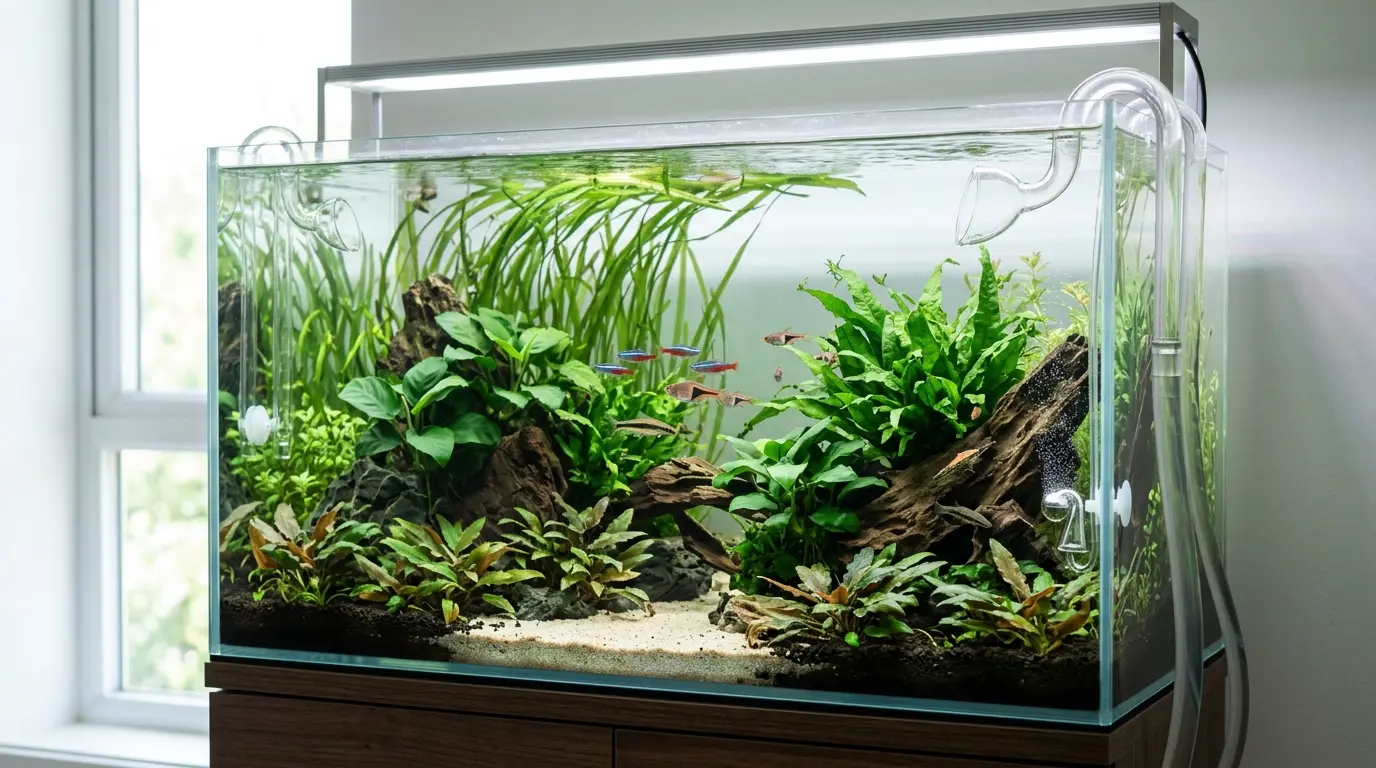
Prevention means making the aquarium more stable, not making it sterile. Plants, fish, bacteria, and algae all share the same water, so extreme changes can create new problems.
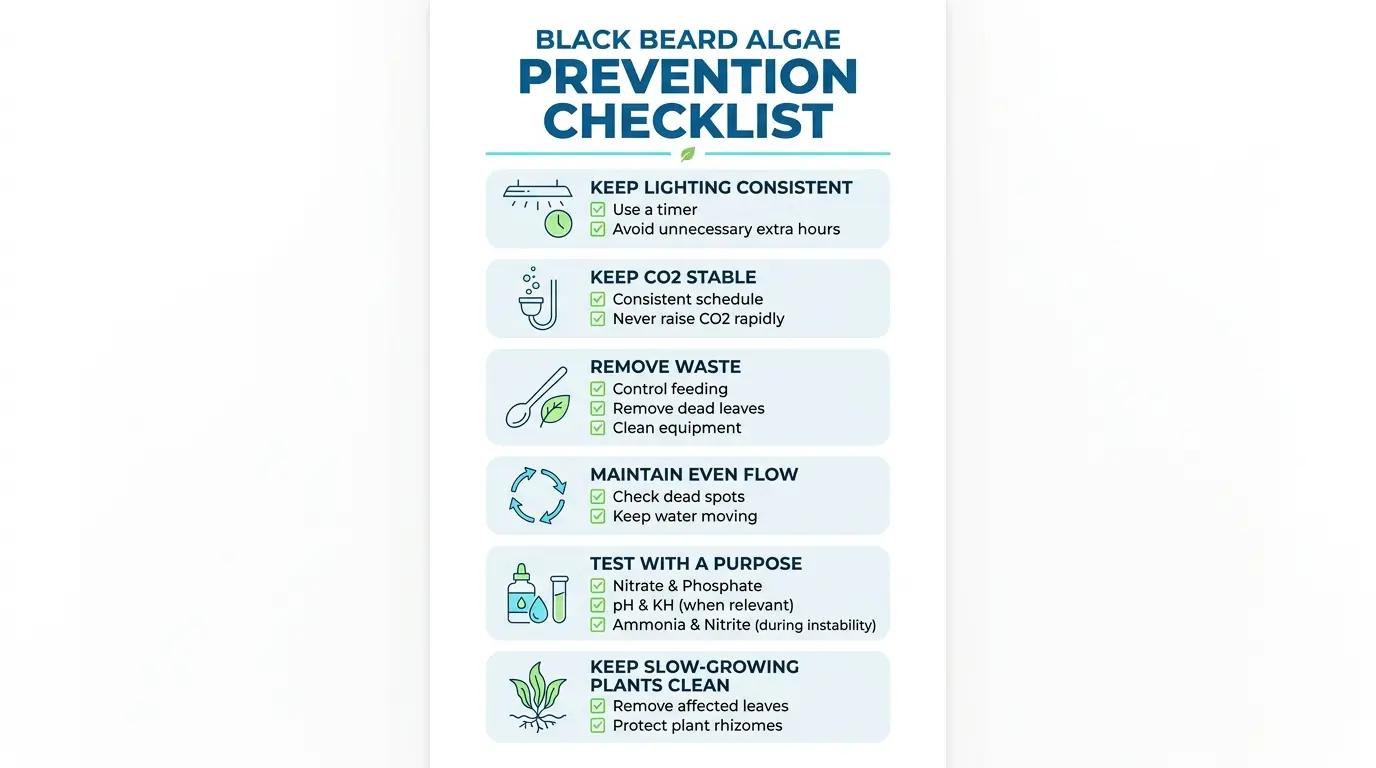
Keep the light schedule steady
Use a timer if possible. Avoid adding extra hours because the plants “look healthy.” If BBA continues to spread, reduce the photoperiod or intensity in small steps and watch plant growth.
Also check for sunlight. A tank near a bright window may receive more light than the aquarium fixture suggests.
Match light to plant demand
High light can support fast plant growth, but it also demands better control of carbon, nutrients, and maintenance. Low-light plants do not always benefit from intense lighting.
If your plants grow slowly and BBA grows quickly, the light may be stronger than the plant mass can use.
Keep CO2 stable when you use it
Run injected CO2 on a consistent schedule. Maintain equipment before flow becomes weak. Watch fish behavior, especially after changes.
If fish gasp, lose balance, or gather at the surface, increase aeration and restore safe oxygen conditions. Do not treat algae at the expense of livestock.
Remove waste before it builds up
Feed a measured amount. Remove dead leaves. Clean clogged equipment. Keep water moving through the whole tank.
A clean filter is useful, but do not replace all biological media or scrub every surface at the same time. Beneficial bacteria live on filter media and other aquarium surfaces.
Test with a purpose
Tests can help you find a change, but a test number is not a complete diagnosis. Compare results over time and record:
- Nitrate
- Phosphate, when relevant
- pH
- Carbonate hardness, if managing CO2 or pH
- Ammonia and nitrite in new or unstable tanks
If ammonia or nitrite is present in an established aquarium, focus on livestock safety and the cause of the water-quality problem first.
Keep slow-growing plants clean
Slow-growing plants often collect algae because their leaves remain in place for months. Gently clean or trim affected leaves before BBA forms a thick mat.
Do not bury the rhizome of Anubias or Java fern. A buried rhizome can rot, weaken the plant, and make algae control harder.
Why Black Beard Algae Keeps Returning
If BBA returns after treatment, the treatment probably removed the visible growth but not the condition that supported it.
Check these causes in order:
- Remaining algae: Small tufts may still be attached to plant bases, filter parts, or wood.
- Dirty equipment: Intakes, hoses, and filter chambers can hold organic debris.
- Uneven flow: The tank may have stagnant areas behind hardscape.
- Changing CO2: Inconsistent injection can cause repeated stress in planted tanks.
- Long or intense lighting: The light load may still exceed plant growth.
- Excess feeding: More food creates more waste.
- Plant decline: Melting leaves and weak growth leave less competition for algae.
- Repeated harsh treatments: Sudden changes can harm plants and livestock without solving the root issue.
Take a photo of the same area every few days. This helps you tell the difference between old algae turning pale and new algae spreading.
BBA that turns red, pink, or gray after treatment may be dying. It still needs to be removed or siphoned away. Color change alone does not prove that the outbreak is solved.
Common Mistakes to Avoid
Do not rely on blackout alone
A blackout may weaken some algae, but it can also stress plants. BBA attached to wood, equipment, or hardy leaves may survive. Blackout treatment does not correct waste, flow, or CO2 problems.
Do not raise CO2 sharply
More CO2 is not automatically better. Fish and shrimp can be harmed by unsafe levels or poor gas exchange. Make changes slowly and observe livestock.
Do not add algae eaters without a care plan
An algae-eating fish still needs the right tank size, diet, water conditions, and social setup. It may ignore mature BBA and may outgrow the aquarium.
Do not remove all algae at once with harsh chemicals
Strong cleaners can damage plants, beneficial bacteria, and animals. They can also leave residue. Physical removal and stable care are usually safer starting points.
Do not chase a perfect nitrate number
A single nitrate reading cannot explain every algae outbreak. Look at plant health, feeding, light, flow, and maintenance together.
Frequently Asked Questions
Is black beard algae harmful to fish?
Black beard algae is not usually toxic to fish. However, a large outbreak can signal poor maintenance, unstable conditions, or excess organic waste. Thick growth may also cover plant leaves and reduce their ability to grow.
Will shrimp eat black beard algae?
Some shrimp may pick at young or weakened BBA, but most should not be treated as a dependable cure. They are more useful for soft films and leftover food. Do not expose shrimp to an untested chemical treatment.
Does hydrogen peroxide kill black beard algae?
Hydrogen peroxide can damage exposed algae, but its success depends on concentration, contact time, surface, and treatment method. It can also harm fish, shrimp, snails, plants, and beneficial microbes. Follow the product label and use extra care with in-tank treatments.
Can I leave black beard algae on driftwood?
You can, but it may spread. If the growth is small and the wood is hard to remove, scrub it and siphon the debris. If BBA covers most of the wood, treating the wood outside the aquarium is easier and safer.
How long does it take to get rid of black beard algae?
Small outbreaks may improve within a few weeks after removal and better care. Heavy outbreaks can take longer because old growth must be removed and new growth must be monitored. A treatment that kills visible algae but leaves the cause unchanged will usually provide only temporary results.
Key Takeaways
- Black beard algae is usually linked to unstable conditions, waste buildup, uneven flow, or excessive light pressure.
- Remove heavily covered leaves and scrub hard surfaces first.
- Siphon loose algae after cleaning.
- Keep light, feeding, flow, and maintenance consistent.
- Treat hydrogen peroxide and liquid carbon as optional tools, not universal cures.
- Protect fish, shrimp, snails, plants, and beneficial bacteria during every treatment.
- If BBA returns, inspect the cause rather than repeating harsher treatment.
Conclusion
The fastest safe path to control black beard algae is usually simple: remove what you can, clean waste from the system, stabilize the tank, and watch for new growth. Avoid drastic changes that may hurt fish or plants.
Start with one affected area today. Trim the worst leaf, brush one hard surface, clean the filter intake, and review the light schedule. Small, steady corrections are more likely to produce a clear aquarium than one aggressive treatment.